From process to reflex
Most receipt tools sell you a process. Download the app. Train your team. Send reminders. Chase compliance. Review reports. It's a workflow you have to maintain — and when you stop maintaining it, receipts stop getting captured.
Maya turns that process into a reflex. Your crew already texts. They already have receipts in their hands at the supply counter. Maya makes the text the system — no app, no login, no training, no reminders. The receipt gets captured because texting is what people do anyway.
That shift — from process to reflex — is where the value starts. But it doesn't stop there. The reflex triggers a chain of value across your entire operation.
Maya turns expense capture from a process into a reflex. By stacking layers of value across the organization, it becomes a true operational system — not just a bookkeeping tool.
The three-layer value stack
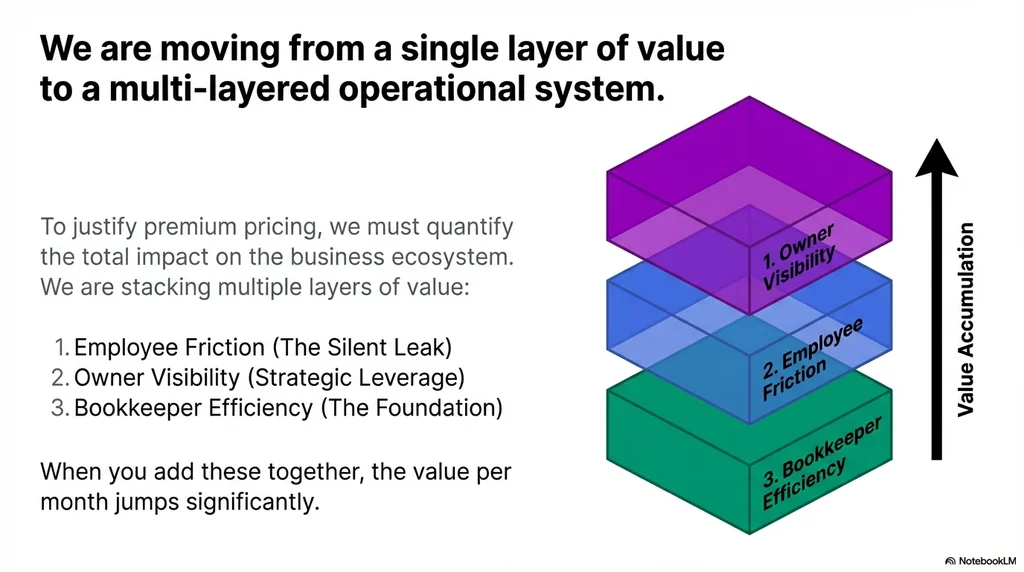
When you look at what Maya actually delivers, the value doesn't live in one place. It stacks across three layers of your business, each one serving a different person:
Bookkeeper Efficiency
Direct labor savingsThe base layer. This is what most people think Maya does — saves the bookkeeper time. No more manual data entry, no more chasing receipts, no more deciphering crumpled paper at month-end. The hours saved are direct, measurable, and the easiest to quantify. If this were the only layer, Maya would still pay for itself. But it's not the only layer.
Employee Friction
Hidden costs of adoption failureThe middle layer. Every expense app fails the same way: your team won't use it. Downloads stall. Accounts go untouched. Reminders get ignored. Receipts still end up in gloveboxes. The cost isn't just the subscription you're paying for nothing — it's the receipts that never get captured, the deductions that get missed, the tax-season scramble that happens anyway. Maya removes the friction entirely. If your team can text, they can use Maya. Zero adoption barrier means zero silent leak.
Owner Visibility
Real-time decision-making powerThe top layer. This is the value most receipt tools never touch. When receipts flow into QuickBooks the day they happen — not 30 days later when the credit card statement arrives — you see project costs in real time. You catch a job going over budget while you can still adjust. You know your cash position without waiting for the bookkeeper's monthly report. You walk into tax season organized instead of scrambling. This is strategic leverage, and it's worth more than the other two layers combined.
Layer 1: Bookkeeper efficiency — the foundation
Let's start with the layer everyone already understands. Your bookkeeper (or you, if you're the bookkeeper) spends hours every week on receipt-related work:
- Chasing receipts from crew members who forgot to turn them in
- Manually entering each receipt into QuickBooks — vendor, date, amount, category
- Matching receipts to credit card transactions at month-end
- Fixing entries that were categorized wrong or posted to the wrong job
- Digging through emails, gloveboxes, and desk drawers for missing receipts
With Maya, the crew texts the receipt at the point of purchase. Maya reads it, classifies it, and creates a QuickBooks draft with the vendor, date, amount, and category already filled in. The bookkeeper reviews and approves. That's it.
The bookkeeper goes from data entry clerk to reviewer. That's a different job — and a different cost.
The math
A typical small business processes 100-200 receipts per month. At 3-4 minutes per receipt for manual entry, that's 5-13 hours of bookkeeper time per month. At $40-60/hour for a bookkeeper, you're spending $200-$780/month on receipt data entry alone.
Maya reduces that to a review pass — maybe 30 seconds per receipt. The same 200 receipts take 1.5 hours. You've reclaimed 4-11 hours of bookkeeper time every month. At $50/hour, that's $200-$550 in direct labor savings — and Maya costs $159/month.
Layer 2: Employee friction — the silent leak
This is the layer most businesses don't measure because they can't see it. But it's where the real money leaks.
Every expense app on the market has the same adoption problem. You roll it out. Half the team downloads it. A quarter actually uses it. Two weeks later, the compliance rate is 10%. The receipts that don't get captured are lost deductions — real money that disappears from your tax return.
Here's what that leak looks like:
- Lost receipts — the crew member who didn't open the app, didn't take the photo, and threw the receipt away. That $84 fuel receipt? Gone. The deduction is gone with it.
- Delayed entry — receipts that sit in a pocket for a week, then get entered with the wrong date, wrong vendor, or wrong job code. The data is wrong even when it's there.
- Turnover cost — training a new crew member on your expense app. Then training the next one when they leave. Then retraining everyone when the app updates its interface.
- Compliance chasing — the owner or office manager spending hours emailing, texting, and reminding people to submit receipts. That's owner time — the most expensive time in the business.
Maya eliminates the friction because there's nothing to adopt. Your crew already texts. They already have the receipt in their hand. The text IS the submission. No app to download, no account to create, no interface to learn, no password to forget, no reminder to ignore.
If your crew can text, they can use Maya. That's not a feature — it's the elimination of the entire adoption problem. And the adoption problem is what kills every other expense tool.
Layer 3: Owner visibility — strategic leverage
This is the layer that justifies the price. The first two layers save you money. This one makes you money.
When receipts sit in a glovebox for 30 days, you're flying blind. You don't know what a job cost until the credit card statement arrives. You don't know if a project is over budget until it's done. You don't know your true cash position until the bookkeeper reconciles everything at month-end.
Maya closes that gap. Every receipt enters QuickBooks the day it's incurred. You see job costs in real time. You catch a project trending over budget while you can still adjust the bid, negotiate with the supplier, or reassign the crew. You know your numbers before the bank does.
The 30-day blind spot is where contractors lose money on jobs they could have saved. Maya closes it.
What visibility is worth
Catching one project that's 15% over budget — and adjusting before it finishes — can save thousands on a single job. Seeing that fuel costs spiked across all crews this month — instead of next month — lets you adjust billing before it eats your margin. Knowing your exact expense position at any moment means you make decisions with data, not guesses.
This isn't theoretical. It's the difference between running a business and reacting to one. And it only happens when receipts flow in real time — which only happens when capture is a reflex, not a process.
What the value looks like when you add it up
Here's a realistic breakdown for a small business processing 150-200 receipts per month with a $50/hour bookkeeper:
| Value Layer | What It Replaces | Monthly Value |
|---|---|---|
| Bookkeeper Efficiency | 8-10 hrs manual entry → 1.5 hrs review | $325-$425 |
| Employee Friction | Lost receipts, compliance chasing, app training | $200-$400 |
| Owner Visibility | Real-time job costs, early budget detection | $500-$2,000+ |
| Total monthly value | $1,025-$2,825+ |
Maya costs $159/month. The realized return is 6-17x the cost, every month. And that's before you factor in the intangibles — less stress at tax time, no audit panic, a bookkeeper who does higher-value work instead of data entry.
When you add these together, the value per month isn't incremental. It compounds. Each layer makes the next one more valuable.
What Maya replaces
If you're already paying for tools to solve pieces of this problem, Maya doesn't add to your stack — it replaces it:
Expense app subscription
$10-$18/user/month. Half your team doesn't use it. You're paying for seats that never log in. Plus the admin time managing licenses and chasing compliance.
Maya
$159/month flat. No per-user fees. No seats to manage. Everyone who can text is already a user. The compliance rate is whatever your texting rate is — which is near 100%.
Bookkeeper receipt entry hours
5-13 hours/month at $40-60/hour. That's bookkeeper time spent on the lowest-value task in the workflow — transcribing numbers from paper to software.
Maya
Drafts are already created. Bookkeeper reviews and approves — 1-2 hours/month. The reclaimed time goes to higher-value work: reconciliation, reporting, advisory.
Shoebox + month-end scramble
Receipts in trucks, pockets, desk drawers. You reconstruct a month of spending from memory and credit card statements. Project codes are guesses. Job costs are unknowable until the job is done.
Maya
Every receipt is in QuickBooks the day it happens, with the image attached. Project codes captured at the point of purchase. Job costs visible in real time. No month-end scramble — the work is already done.
Why the value compounds, not just adds
Here's the thing about the three layers: they reinforce each other. The foundation (bookkeeper efficiency) only works because the middle layer (employee friction) is solved — if receipts don't come in, the bookkeeper has nothing to review. And the top layer (owner visibility) only works because the foundation is solid — if drafts are inaccurate or missing, the real-time numbers are wrong.
Maya is one system that delivers all three layers simultaneously. You don't buy the receipt scanner and then add the adoption solution and then add the reporting tool. The text-message reflex triggers the bookkeeper efficiency, which enables the owner visibility. One input, three outputs.
Most tools give you one layer and charge you for it. Maya gives you all three because they're the same thing — capture done right.
The bottom line
$159/month is not cheap for a receipt tool. But Maya isn't a receipt tool. It's an operational system that happens to start with receipt capture.
The bookkeeper efficiency alone covers the cost. The employee friction savings are money you're currently losing without knowing it. The owner visibility is the difference between running your business with data and running it on hope.
When you stack all three, the question isn't whether Maya is worth $159/month. The question is whether you can afford to keep losing the value you're already losing without it.