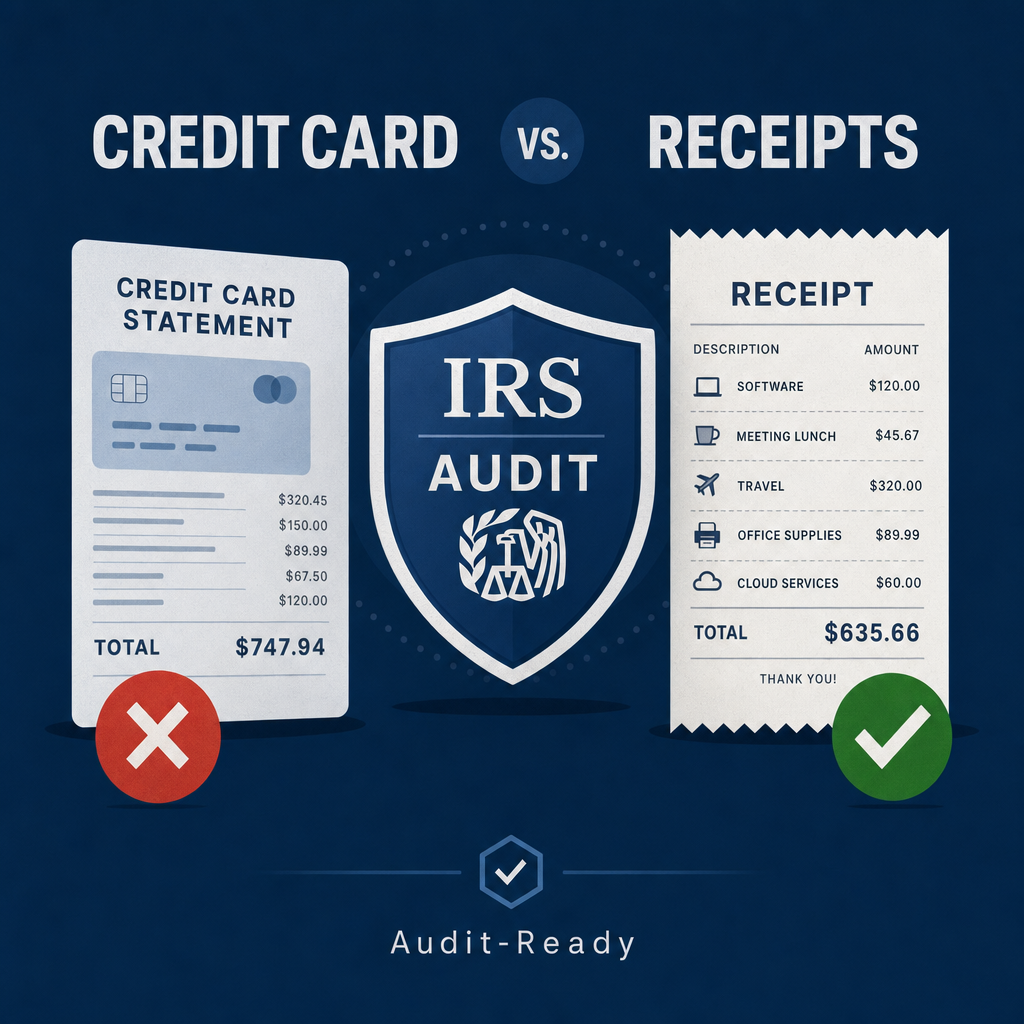
The statement shows the charge. The auditor wants the receipt.
You hand the auditor your credit card statement. It shows "HOME DEPOT, $247.83, 03/15." You figure that's enough. It's on the card, it's a business expense, case closed.
It isn't. The statement proves a payment happened. It doesn't prove what you bought. A $247 charge at Home Depot could be job materials. It could also be a new grill for your deck. The IRS doesn't assume. They ask for the receipt that shows the line items.
If you don't have it, the deduction is in trouble. Not "maybe" trouble. Real trouble.
What the IRS actually requires
The IRS calls it "documentary evidence." That's a specific term, not a vibe. To substantiate a business expense deduction, you need a record that shows four things:
- Vendor name — who you paid
- Date — when you paid
- Amount — what you paid
- What you bought — the items or services, not just the total
A credit card statement covers the first three. It fails on the fourth. The statement shows the total. The receipt shows the line items. The IRS wants the line items, because that's what proves the expense was for business, not personal.
A statement says "you spent $247." A receipt says "you spent $247 on 50 feet of copper pipe and a flux kit." Only one of those answers the auditor's question.
Statement vs. receipt, side by side
- Vendor name
- Date of charge
- Total amount
- Shows you paid
- No itemization
- No proof it was business
- One line per charge
- Vendor name
- Date and time
- Total amount
- Shows you paid
- Line items listed
- Business purpose evident
- Payment method shown
The statement is a receipt for the payment. The receipt is a receipt for the purchase. The IRS wants both. The statement alone is missing the part that matters.
The $75 myth and the Cohan rule
You may have heard the IRS doesn't require receipts under $75. That's a real rule, with a real catch: it doesn't apply to lodging, and it's not a free pass. It's tied to the Cohan rule, a decades-old doctrine that lets the IRS estimate deductible expenses when exact records are missing.
Here's the problem with relying on it. "Estimate" means the auditor decides what's reasonable. If they estimate your meals lower than you claimed, you lose the difference. If they decide a charge looks personal, you lose the whole thing. The Cohan rule is a fallback for when you've already lost your receipts. It's not a strategy. It's a penalty for bad recordkeeping.
If you have the receipts, none of this comes up. The auditor looks at the receipt, sees the line items, and moves on. The whole fight never starts.
Statements tell the IRS you spent money. Receipts tell them it was business. Without the receipts, every charge is a question. With them, it's an answer.
Where your receipts actually are
Be honest. Where are your receipts right now?
- In a shoebox in the truck
- Photographed on three different phones, none of them yours
- Stuffed in a wallet until it's too thick to close
- In the trash at the supply store because "I'll remember"
- In an email folder you opened once in February
If an audit happened tomorrow, how long would it take you to match every credit card charge to a receipt? For most contractors, the honest answer is "weeks, if ever." And "if ever" is how deductions die.
How Maya creates the audit trail automatically
Maya doesn't wait for tax season. The moment your crew texts a receipt, the image and the extracted data land in QuickBooks as a draft. The receipt is attached to the transaction. The vendor, amount, and date are filled in. The line items are on the image.
By the time an auditor asks "what was this $247 charge at Home Depot?", the answer is already in your books. You open the transaction in QuickBooks, and the receipt is right there, attached, with the line items visible. No shoebox. No phone calls to the guy who quit. No "I think that was for the Johnson job."
Every charge has a receipt. Every receipt is attached to the transaction it belongs to. That's what audit-ready looks like.
The day it happens vs. the day you need it
The reason most contractors aren't audit-ready isn't laziness. It's timing. The receipt exists at the moment of purchase. By the time you need it — months later, when the audit notice arrives — it's gone. You can't reconstruct it. You can't ask the supply store to reprint it. You can only hope.
Maya closes the gap between the day it happens and the day you need it. Your lead carpenter texts the receipt from the Home Depot counter at 11:47 AM. At 11:48 AM, it's in QuickBooks. The image, the vendor, the amount, the date. Attached to a draft. Sitting there, waiting, for the day someone asks.
That day might never come. Most audits don't happen. But if it does, you're not digging through a shoebox in April. You're opening QuickBooks and pointing at the receipt.
What this is worth
Think about what an audit costs you if you're not ready. Not just the disallowed deductions. The time. The accountant fees. The stress. The weeks of pulling records that should have existed all along.
Now think about what it costs to be ready. With Maya, it's one text message per receipt. That's the entire burden. Your crew already has their phones out at the counter. They take a photo and send it to your Maya number. The audit trail builds itself, one receipt at a time, every day, without anyone thinking about audits.
You're not buying audit insurance. You're building the records that make an audit a non-event. The auditor asks for receipts. You already have them. That's the whole product.